

Table of Contents
ToggleWhat MRL compliance really means
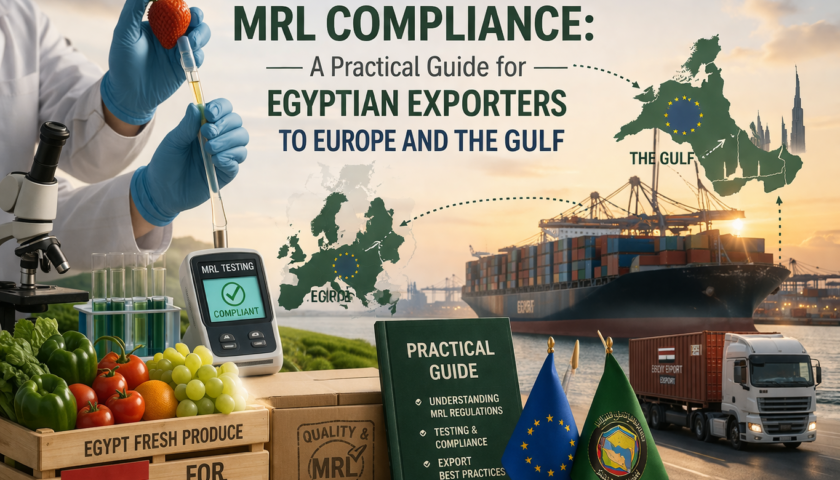
For importers, retailers, and foodservice buyers, MRL compliance is a signal of operational discipline. It suggests that the exporter understands agronomic control, documentation, pre-harvest intervals, traceability, and shipment verification. That is why buyers increasingly prefer to work with partners who can supply not just product, but confidence. At Il Mondo Export, that confidence begins at origin and continues through every stage of the export chain.
Meeting EU and Gulf requirements with precision
In the Gulf, the picture is more layered. In Saudi Arabia, national or GCC rules apply first; if no local limit exists, Codex may be used, and when Codex is absent, authorities may look to EU and U.S. references and apply the lower threshold. In the United Arab Emirates, standards are generally aligned with Codex, while European and other international references may also be used where specific local or GSO standards are not available. For Egyptian exporters, that means compliance must be checked market by market, buyer by buyer, and crop by crop. USDA FAS Saudi Arabia Report USDA FAS UAE Report
- Use compost, manure, or green plant waste to feed the soil and make it soft and rich.
- Change what you plant in each area every season. Different crops use different nutrients.
- Grow plants like clover or mustard after harvest to protect and feed the soil.
- Too much digging breaks the soil structure and harms good microbes. Try low or no-till methods.
How Il Mondo Export approaches MRL compliance
At Il Mondo Export, the right way to manage MRL compliance is to start before planting, not before shipping. That means aligning production plans with the intended destination market, understanding active-substance restrictions, monitoring agricultural practices, and building traceability into the supply chain from the beginning. Egypt’s National Food Safety Authority has explicitly stated that exported products must comply with the regulation of the importing country, which reinforces the need for market-specific planning at every stage. USDA FAS Egypt Report
That approach becomes even more important as standards evolve. A joint FAO and EBRD initiative in Egypt highlighted the growing importance of pesticide management, traceability, regulatory awareness, and crop-specific compliance guidance to help Egyptian horticultural products remain competitive in high-value markets. For Il Mondo Export, this is exactly the standard modern buyers expect: transparent sourcing, disciplined field practices, and documentation that stands up to scrutiny. FAO
Why compliance is a commercial advantage, not just a safeguard
Too often, MRL compliance is viewed only as a defensive necessity. In reality, it is also a growth advantage. Buyers in Europe and the Gulf want suppliers who reduce risk, protect brand reputation, and make procurement easier. When an exporter can demonstrate residue management, pre-shipment verification, and full traceability, it becomes easier for the buyer to approve programs, expand volumes, and commit to longer-term sourcing relationships.
This is where Il Mondo Export’s positioning matters. The company’s value is not simply in moving produce from Egypt to international markets. The value lies in helping buyers source with greater certainty, stronger quality control, and fewer surprises at destination. In competitive B2B trade, that reliability is often what separates a transactional supplier from a preferred export partner.
A practical message for international buyers
For international buyers, the question is no longer whether Egyptian produce can compete. It can. The real question is which export partner has the systems, discipline, and commercial mindset to deliver compliant shipments consistently. That is why Il Mondo Export places such importance on buyer alignment, specification-led sourcing, and export programs built around real market requirements rather than assumptions.
Conclusion
MRL compliance is shaping the future of Egyptian agricultural exports to Europe and the Gulf. Exporters that treat it as a documentation issue will always be reacting. Exporters that treat it as part of a broader quality and market-access strategy will be better positioned to win. At Il Mondo Export, we believe the strongest export relationships are built on exactly that foundation: compliance, transparency, and confidence from farm to final destination.
Frequently Asked Questions About Il Mondo Export
Common questions from procurement managers and importers about our programs and products.
What is MRL compliance in agricultural exports?
MRL compliance means produce meets the pesticide residue limits required by the destination market. For exporters, the importing country’s rules are often the decisive benchmark. USDA FAS Egypt Report
Why is MRL compliance important for Europe and Gulf markets?
Because both regions monitor pesticide residues closely, and non-compliance can lead to rejection, stricter inspections, or commercial loss. European Commission EFSA
Do Gulf market standards follow the same rules as the EU?
Not always. Gulf countries may apply local or GCC standards first, then Codex, and in some cases EU or U.S. references where local limits do not exist. USDA FAS Saudi Arabia Report USDA FAS UAE Report