Contract Farming & Supply Programs
C ompare contract farming and spot-market sourcing for produce imports, and learn which model best fits your pricing, quality, traceability, and supply goals.
For produce importers, one of the most important sourcing decisions is not only where to buy, but how to buy. Should the program be built around structured contract farming, or should it remain flexible through spot-market purchasing? The answer depends on what the buyer values most: supply security, pricing flexibility, quality control, traceability, or speed of execution. At Il Mondo Export, we do not treat this as a theoretical choice. Our structured contract farming solutions are designed to help buyers reduce sourcing uncertainty and improve long-term supply performance.
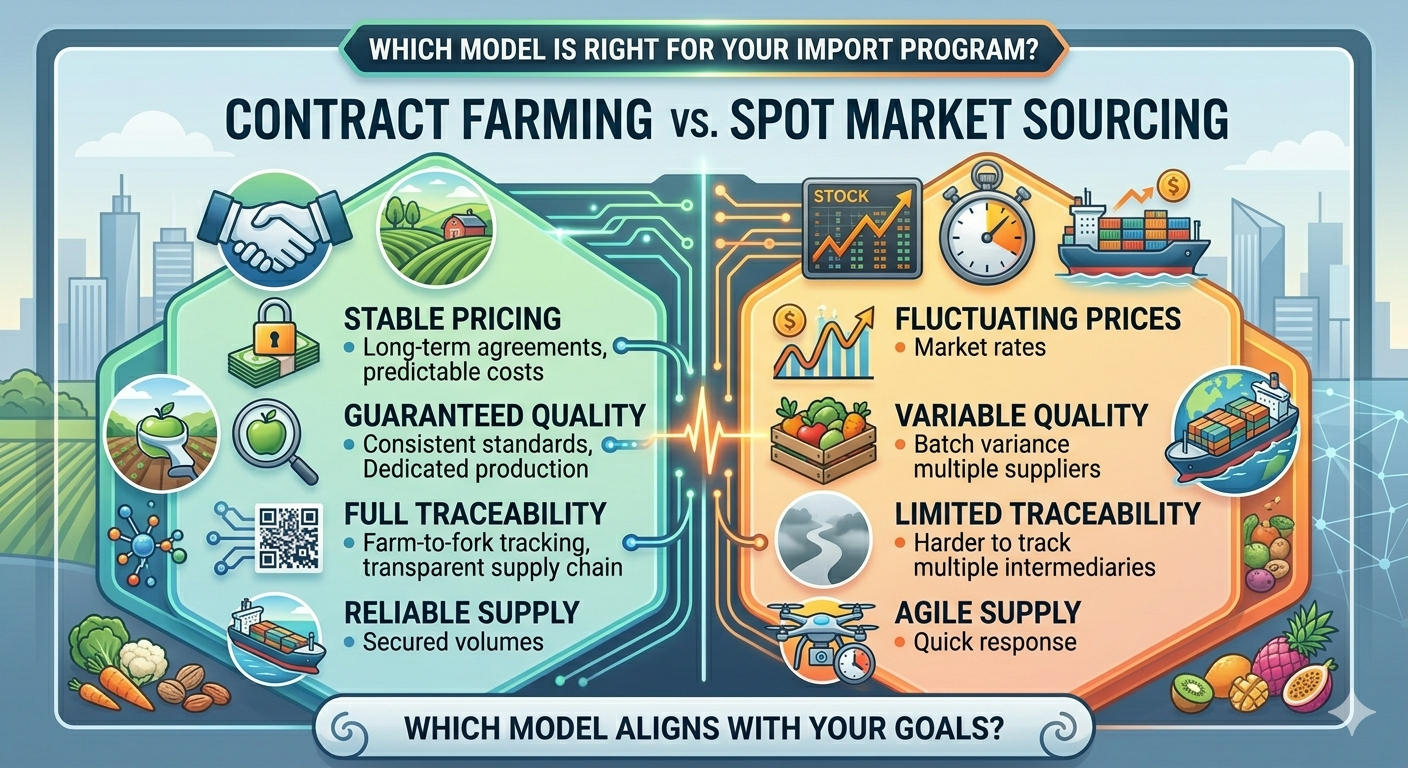
Table of Contents
ToggleWhat contract farming offers
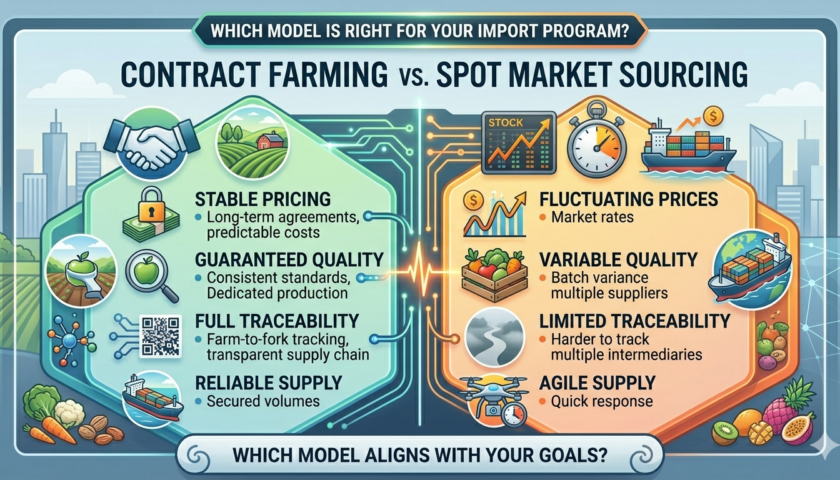
FAO defines contract farming as an agreement between farmers and buyers that sets production and marketing terms in advance, including factors such as quality, quantity, timing, and often technical support or input provision. The World Bank adds that contract farming can help integrate producers into modern value chains by combining market access with technical assistance and clearer production control. In buyer terms, this means greater visibility before harvest and a better chance of getting exactly the product profile required. FAO World Bank Group
FAO also notes that when organized well, contract farming can reduce uncertainty versus open-market buying and can deliver more consistent quality and more reliable production for sponsors or buyers. That makes it especially useful when importers need export-grade product with tighter quality or compliance requirements. For buyers seeking deeper sourcing control, tailored contract farming programs provide a structured way to align production with market requirements.
What the spot market offers
Spot-market buying gives importers flexibility. It allows them to respond quickly to changing prices, short-term gaps, or unexpected demand. It can work well for buyers who have broader product tolerances, who are comfortable shopping the market week by week, or who want to avoid long-term volume commitments. In fast-moving produce categories, that flexibility can be commercially useful.
But the trade-off is control. Spot buying can increase exposure to inconsistent sizing, uneven quality, reduced traceability, and variable availability. In categories where food safety, retailer approval, or detailed specifications matter, spot-market procurement can become expensive in indirect ways even if the invoice price looks attractive.
This becomes particularly important when MRL and compliance management are central to supplier approval.
When contract farming is usually the better fit
Contract farming is usually the better option when the buyer needs one or more of the following: stable volume, consistent specifications, stronger traceability, lower compliance risk, or integrated field-level coordination. The World Bank specifically highlights contract farming as useful where processors or buyers need uniformity and controlled production conditions. The IFAD research on Egypt also shows that structured contract-farming systems can help bring smallholders into export-oriented value chains more effectively, especially when growers are organized into associations that support certification and buyer requirements. World Bank Group IFAD
For import programs built around supermarket supply, private label, foodservice consistency, or strict MRL management, contract farming often creates the better long-term foundation. Importers serving Europe should also monitor changing EU residue requirements when evaluating sourcing models.
When the spot market may be the better fit
In reality, many importers do not choose one model exclusively. The smartest structure is often a hybrid model: secure a base volume through contract farming or structured sourcing, then use the spot market to top up during promotional demand, temporary shortages, or pricing opportunities. That approach gives buyers a more stable floor without giving up all flexibility.
This is often the model Il Mondo Export recommends. It allows buyers to protect core supply while remaining commercially agile. It also helps reduce the risk of overcommitting in a volatile produce environment.
The smartest import strategy is often hybrid
In reality, many importers do not choose one model exclusively. The smartest structure is often a hybrid model: secure a base volume through contract farming or structured sourcing, then use the spot market to top up during promotional demand, temporary shortages, or pricing opportunities. That approach gives buyers a more stable floor without giving up all flexibility. This strategy can be particularly useful in categories affected by seasonal pricing windows and fluctuating market demand.
This is often the model Il Mondo Export recommends. It allows buyers to protect core supply while remaining commercially agile. It also helps reduce the risk of overcommitting in a volatile produce environment.
In reality, many importers do not choose one model exclusively. The smartest structure is often a hybrid model: secure a base volume through contract farming or structured sourcing, then use the spot market to top up during promotional demand, temporary shortages, or pricing opportunities. That approach gives buyers a more stable floor without giving up all flexibility.
This is often the model Il Mondo Export recommends. It allows buyers to protect core supply while remaining commercially agile. It also helps reduce the risk of overcommitting in a volatile produce environment.
How Il Mondo Export supports the decision
The right sourcing model depends on the buyer’s market, category, risk tolerance, and sales channel. A wholesale buyer serving fast-moving market demand may prefer more spot flexibility. A retailer, importer-distributor, or processor may need a more controlled contract structure.
Different Egyptian produce categories may require different sourcing structures depending on market expectations.
Il Mondo Export’s role is to help buyers choose the sourcing model that fits the commercial reality of their program rather than forcing a one-size-fits-all approach.
Need Help Structuring Your Import Program?
IL Mondo Export helps international buyers design sourcing strategies that balance pricing, supply security, compliance, and operational flexibility.
Conclusion
Contract farming and spot-market sourcing both have a place in produce imports. The real question is not which one is universally better, but which one is better for your import program. If you need predictability, traceability, and stronger control, contract farming is often the stronger choice. If you need speed and pricing flexibility, the spot market may be useful. And in many cases, the strongest solution is a mix of both. That is where Il Mondo Export can create value: by helping international buyers build sourcing models that are commercially realistic, operationally sound, and aligned with destination-market expectations.
Frequently Asked Questions AboutContract Farming vs Spot Market
What is the main advantage of contract farming?
It gives buyers more control over quality, timing, traceability, and supply consistency. FAO World Bank Group
What is the main advantage of the spot market?
It offers flexibility and can allow buyers to respond quickly to short-term pricing and availability opportunities.
Which model is better for retailer or compliance-sensitive programs?
Contract farming is usually better when the program requires tighter quality consistency, traceability, and compliance control. FAO
Can importers use both models together?
Yes. A hybrid strategy is often the most commercially effective, with contract volume for stability and spot buying for flexibility.