

Import Guides & Buyer EducationCompliance & Food Safety
Table of Contents
ToggleKEY TAKEAWAYS
- Contract farming programs deliver 8-12% better quality outcomes compared to spot purchasing
- Strategic volume commitments of 5+ containers monthly typically secure 10-15% pricing improvements
- Fixed pricing mechanisms reduce exposure to the 15-20% seasonal price volatility common in produce markets
- Season contracts with flexible volume bands balance supply security with demand responsiveness
- Contract structure decisions should align with category strategy and relationship maturity
The Contract Decision Framework

European importers sourcing Egyptian produce face a fundamental commercial decision: how to structure supplier relationships and purchasing commitments. This decision carries significant implications for supply security, pricing, quality consistency, and ultimately, customer satisfaction and margin performance.
The spectrum of contract structures ranges from pure spot transactions at one extreme to dedicated contract farming programs at the other. Between these poles exist multiple hybrid approaches that balance competing priorities. Understanding this spectrum—and matching contract structures to specific circumstances—enables importers to optimize outcomes across multiple dimensions simultaneously.
Contract structure decisions should flow from category strategy rather than prevailing market conditions alone. Categories requiring consistent quality and reliable supply justify different structures than promotional or opportunistic purchases. The analysis that follows provides a framework for making these decisions systematically, considering both immediate requirements and longer-term relationship development.
This framework assumes ongoing commercial relationships with established Egyptian suppliers rather than first-time transactions. Initial supplier engagement typically involves trial spot purchases before transitioning to structured arrangements. The contract structures discussed below apply most directly to importers with established supplier relationships and verified quality track records.
Understanding the Contract Structure Spectrum
The range of available contract structures can be conceptualized as a spectrum with distinct characteristics at each point.
Spot Purchasing represents the pure market transaction approach. Buyers purchase on an as-needed basis, accepting prevailing market prices and available supply. This approach offers maximum flexibility and minimal commitment. However, spot purchasing provides no supply security during tight supply periods, exposes buyers to market price volatility, and offers no foundation for relationship development with suppliers.
During the February-April Egyptian Valencia orange peak season, spot buyers frequently encounter availability constraints and premium pricing that erode program economics. Suppliers naturally prioritize committed customers during periods of strong demand—spot purchasers find themselves competing for whatever supply remains after contract commitments are fulfilled.
Season Contracts represent the entry point into structured commercial arrangements. Buyers commit to purchasing throughout a specific season (e.g., December-June for Valencia oranges) with agreed pricing mechanisms and volume parameters. This approach provides supply allocation priority, pricing stability, and a foundation for supplier relationship development.
Season contracts typically specify pricing through one of several mechanisms: fixed pricing agreed at contract signing, formula pricing linked to published market indices, or tiered pricing that rewards volume commitment with incrementally better rates. Each pricing mechanism carries distinct risk and reward profiles that importers should evaluate carefully against their market positioning and customer commitments.
Contract Farming Programs represent the most structured arrangement available. Buyers secure dedicated production capacity, often on exclusive or priority basis, in exchange for substantial volume commitments extending across multiple seasons. This approach delivers the highest quality consistency, maximum supply security, and strongest supplier relationship development—but requires correspondingly significant commitment and investment.
Contract farming arrangements particularly suit importers with established retail or foodservice programs requiring predictable supply for customer commitments. The dedicated production relationship enables suppliers to plan growing programs optimized for buyer specifications, including custom varieties, specific harvest timing, and quality parameters precisely matched to end-market requirements.
Contract Farming: Structure and Benefits
Contract farming arrangements with Egyptian suppliers deliver measurable advantages across multiple performance dimensions. Understanding these structures enables importers to evaluate whether this approach suits their specific circumstances.
Production Planning Integration: Contract farming programs engage suppliers in advance planning that optimizes growing programs for buyer requirements. Rather than producing to generic market specifications, contract farmers grow specifically for committed buyers. This integration improves variety selection, harvest timing, and quality consistency that generic production cannot match.
Quality Specification Optimization: Contract arrangements enable buyers to specify quality parameters precisely matched to their customer requirements. Retailers requiring specific berry sizes, brix levels, or appearance standards can communicate these requirements to dedicated producers who optimize growing practices accordingly. The resulting quality alignment reduces waste, improves customer satisfaction, and supports premium positioning.
Supply Allocation Priority: During periods of tight supply—when market demand exceeds available production—contract farming customers receive allocation priority. Egyptian suppliers naturally honor commitments to contract farmers before allocating available supply to spot purchasers. This priority access proves particularly valuable during peak demand periods such as Valentine's, Easter, and Ramadan.
Pricing Advantages: Volume commitment in exchange for pricing consideration represents the fundamental exchange in contract farming arrangements. Suppliers gain production planning security and guaranteed markets; buyers gain pricing advantages and supply priority. The magnitude of pricing benefits typically correlates with volume commitment levels—larger commitments generally secure proportionally better pricing.
Typical Commitment Thresholds: Contract farming arrangements with Egyptian suppliers generally require minimum volume commitments of approximately 5 containers per month across a 6-12 month program period. Lower volume buyers may find season contracts with volume bands more appropriate than dedicated farming arrangements. The threshold varies by supplier and product category based on production scale and commercial policies.
Season Contracts: Structure and Application
Season contracts provide structured purchasing arrangements without the full commitment required for dedicated farming programs. This approach suits importers seeking supply security and pricing stability while maintaining flexibility to adjust volumes based on market conditions.
Pricing Mechanisms: Season contracts typically utilize one of three pricing approaches. Fixed pricing establishes a specific price at contract signing that remains constant throughout the contract period. This approach provides maximum price certainty but exposes buyers to opportunity risk if market prices decline below contract levels. Formula pricing links contract prices to published market indices (such as FAO price reports or industry benchmarks), adjusting periodically based on market movements. Tiered pricing provides volume-based discounts, with pricing improving as committed volumes increase.
Volume Parameters: Effective season contracts specify minimum and maximum volume commitments, often through band structures. A typical band might specify minimum commitment of 3 containers per week with maximum flexibility of 5 containers, allowing buyers to adjust within defined ranges based on actual demand. Band structures protect both parties—suppliers gain minimum volume security; buyers retain flexibility to respond to demand variation.
Force Majeure Provisions: Standard season contracts include force majeure provisions addressing circumstances beyond either party's control—weather events, political situations, transport disruptions, or regulatory changes. These provisions typically suspend obligations temporarily without penalty while defining maximum suspension periods and termination rights if force majeure extends beyond specified durations.
Quality Standards and Rejection Procedures: Clear specification of quality standards, inspection procedures, and rejection protocols prevents disputes that damage relationships. Contracts should reference specific quality parameters (brix minimums, sizing standards, appearance requirements) and establish whether inspection occurs pre-shipment, at arrival, or both. Third-party inspection options provide objective quality verification that protects both parties.
Volume Commitment Strategies
Strategic volume commitment decisions balance multiple considerations including supply security, margin protection, and flexibility requirements.
Commitment Calibration: The appropriate commitment level depends on demand predictability, customer contract structures, and risk tolerance. Importers with committed customer volumes should match supplier commitments to these customer obligations, providing supply security for firm sales while using spot purchases to serve demand uncertainty. This approach minimizes overcommitment risk while securing supply for known requirements.
Spot-Committed Balance: Many importers maintain portfolios combining contract commitments with spot purchasing flexibility. A common approach commits 70-80% of expected volume through contracts while reserving 20-30% for spot purchases that enable responsive adjustment to demand variation. This balance provides supply security and pricing stability for the committed portion while retaining flexibility for the remainder.
Seasonal Timing: Volume commitment decisions vary across the production season. Commitment early in the season (before supply becomes available) generally secures better pricing but requires forecasting demand before market conditions fully develop. Mid-season commitment balances pricing opportunity against demand visibility. Late-season commitment provides maximum demand information but may face tighter supply availability and higher pricing.
Multi-Year Considerations: Volume commitment benefits compound across multiple seasons. Suppliers investing in relationship development and quality optimization for committed buyers gain confidence that these investments will generate returns through sustained business relationships. Importers who demonstrate commitment through multi-year agreements generally receive progressively better terms as relationships mature.
Pricing Mechanisms: Evaluating Options
Contract pricing mechanisms determine how price risk and opportunity distribute between buyers and sellers. Understanding these mechanisms enables importers to select approaches aligned with their risk tolerance and market positioning.
Fixed Pricing Advantages: Fixed pricing provides complete certainty for margin planning and customer pricing. Importers with committed retail or foodservice pricing benefit from knowing exact product costs throughout contract periods. However, fixed pricing leaves importers unable to benefit if market prices decline below contract levels.
Formula Pricing Advantages: Formula pricing links contract prices to objective market references, adjusting periodically based on market movements. This approach maintains alignment between contract pricing and market conditions, benefiting both parties during periods of price movement in either direction. Importers who resell with pricing linked to market conditions may prefer formula approaches that maintain margin consistency.
Market Index Selection: Formula pricing requires selecting appropriate market indices. Egyptian produce exports reference multiple potential indices including FAO price reports, regional market publications, and commodity exchange prices where available. Contract parties should agree on index selection and calculation methodology at contract signing to prevent disputes.
Tiered Pricing Structures: Volume-based tiered pricing provides straightforward incentive mechanisms that reward commitment with incrementally better pricing. A typical tiered structure might specify base pricing at minimum commitment volumes with specified pricing improvements at each tier threshold (e.g., 5% better pricing for commitments exceeding 10 containers monthly). These structures align buyer and supplier interests by rewarding volume growth.
Contract Duration Considerations
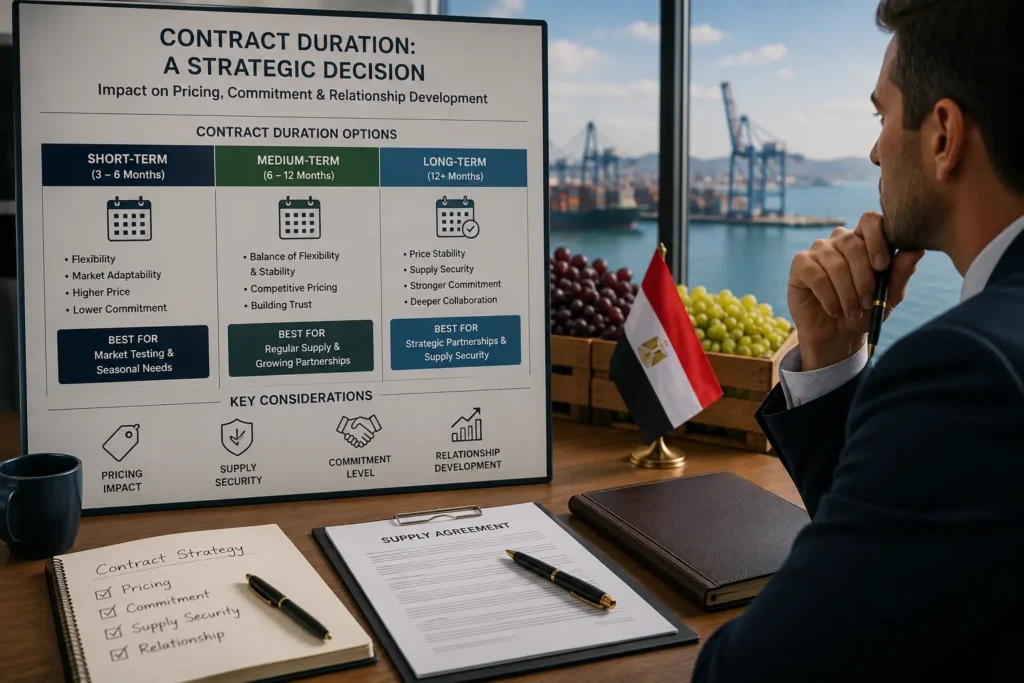
Contract duration represents a significant strategic decision that affects pricing, commitment, and relationship development.
Single Season Contracts: One-season contracts provide natural commitment boundaries that align with annual planning cycles. This approach suits importers who prefer annual commitment review, uncertain category outlook, or relationship development in early stages. Single-season contracts may secure less favorable terms than multi-year arrangements but provide flexibility to adjust supplier relationships annually.
Multi-Year Contracts: Multi-year arrangements—typically two to three years—enable deeper supplier commitment and correspondingly better commercial terms. Suppliers investing in dedicated production capacity, custom variety development, or quality system improvements for multi-year buyers gain confidence that these investments will generate sustained returns. Importers gain pricing advantages and supply security while building relationship depth that improves operational coordination.
Rolling Renewal Approaches: Some importers and suppliers utilize rolling contracts with annual renewal that maintain multi-year relationship continuity while providing periodic term renegotiation opportunities. This approach balances relationship stability with commercial flexibility, enabling terms to adjust as market conditions and relationship dynamics evolve.
Building Effective Contract Relationships
Contract structures create frameworks; relationship quality determines implementation success. Effective contract relationships require ongoing communication, mutual understanding, and collaborative problem-solving.
Communication Protocols: Establish clear communication channels and cadences that enable proactive information sharing. Weekly email updates during active seasons, bi-weekly video calls for strategic discussions, and quarterly business reviews provide structure for ongoing relationship management. Communication protocols should address order processing, shipping notifications, quality feedback, and issue escalation procedures.
Joint Planning Activities: Annual planning sessions before each season enable collaborative demand forecasting, production scheduling, and opportunity identification. These sessions strengthen relationships while improving planning accuracy. Suppliers who understand buyer programs can proactively address requirements; buyers who understand supplier constraints can plan realistically.
Performance Review Processes: Regular performance reviews—quarterly during active seasons—enable issue identification and continuous improvement. Reviews should address quality metrics, delivery performance, communication effectiveness, and commercial terms. Constructive feedback improves performance; recognition of excellence reinforces positive behaviors.
Issue Resolution Mechanisms: Contract disputes inevitably arise despite good faith efforts. Pre-established resolution mechanisms—escalation procedures, mediation options, arbitration provisions—provide frameworks for addressing issues without relationship damage. Most disputes resolve through direct negotiation once both parties understand underlying interests and constraints.
FAQ AboutContract Structure Decisions
What volume commitment is typically required for contract farming arrangements with Egyptian suppliers?
Contract farming programs generally require minimum commitments of approximately 5 containers per month across 6-12 month program periods. However, thresholds vary by supplier based on production scale and commercial policies. Some suppliers offer flexible farming arrangements with lower minimums in exchange for less favorable pricing terms.
How should importers handle pricing when market prices fall below contract levels?
Contract pricing mechanisms determine outcome during declining markets. Fixed pricing protects importers from declining market prices—contract prices remain locked regardless of market movement. Formula pricing adjusts with market reference indices, providing automatic price reduction when markets decline. Spot purchasing provides maximum flexibility but no supply security during tight supply periods.
What force majeure protections should Egyptian produce contracts include?
Effective force majeure provisions should define triggering events (weather, political situations, transport disruptions), suspension procedures, notification requirements, and maximum suspension periods. Contracts should address whether force majeure periods extend contract duration or trigger termination rights. Clear provisions prevent disputes when extraordinary circumstances disrupt normal operations.
How do multi-year contracts compare to annual agreements?
Multi-year contracts typically secure better pricing and priority allocation in exchange for extended commitment. Terms improve progressively with demonstrated reliability—first-year contracts may offer moderate advantages; third-year contracts often secure the most favorable pricing and allocation priority. However, multi-year commitment requires confidence in demand stability and supplier performance track record.
What role does spot purchasing play in structured procurement programs?
Most sophisticated importers maintain portfolio approaches combining contract commitments with spot purchasing flexibility. Typical allocations commit 70-80% of expected volume through contracts while reserving 20-30% for spot purchases that enable demand responsiveness. This balance provides supply security and pricing stability for committed volumes while retaining flexibility for demand variation.
How should contracts address quality disputes?
Contracts should specify quality standards precisely, define inspection procedures (pre-shipment, arrival, or both), identify responsible parties for inspection costs, and establish rejection and return procedures. Third-party inspection options provide objective verification that protects both parties. Clear documentation requirements ensure quality assessments can be verified if disputes arise.
Conclusion: Strategic Contract Decisions
Contract structure decisions carry lasting implications for supply security, pricing, and relationship development. The appropriate approach depends on category strategy, demand predictability, supplier relationship maturity, and risk tolerance. No single structure suits all circumstances—the framework presented here enables systematic evaluation of options against specific requirements.
European importers who invest in contract structure optimization—matching arrangements to category needs, building supplier relationships, and implementing effective management processes—achieve measurably better outcomes across quality consistency, supply reliability, and commercial performance. The effort required to develop sophisticated procurement programs generates returns that compound across seasons through improved terms, priority access, and operational efficiency.
Building effective contract relationships requires investment in communication, planning, and performance management. The transaction mechanics of contract formation represent only the beginning; ongoing relationship cultivation determines whether structural advantages translate into actual performance improvement. Importers who approach supplier relationships as strategic partnerships—investing in mutual success—achieve outcomes that transactional approaches cannot match.